
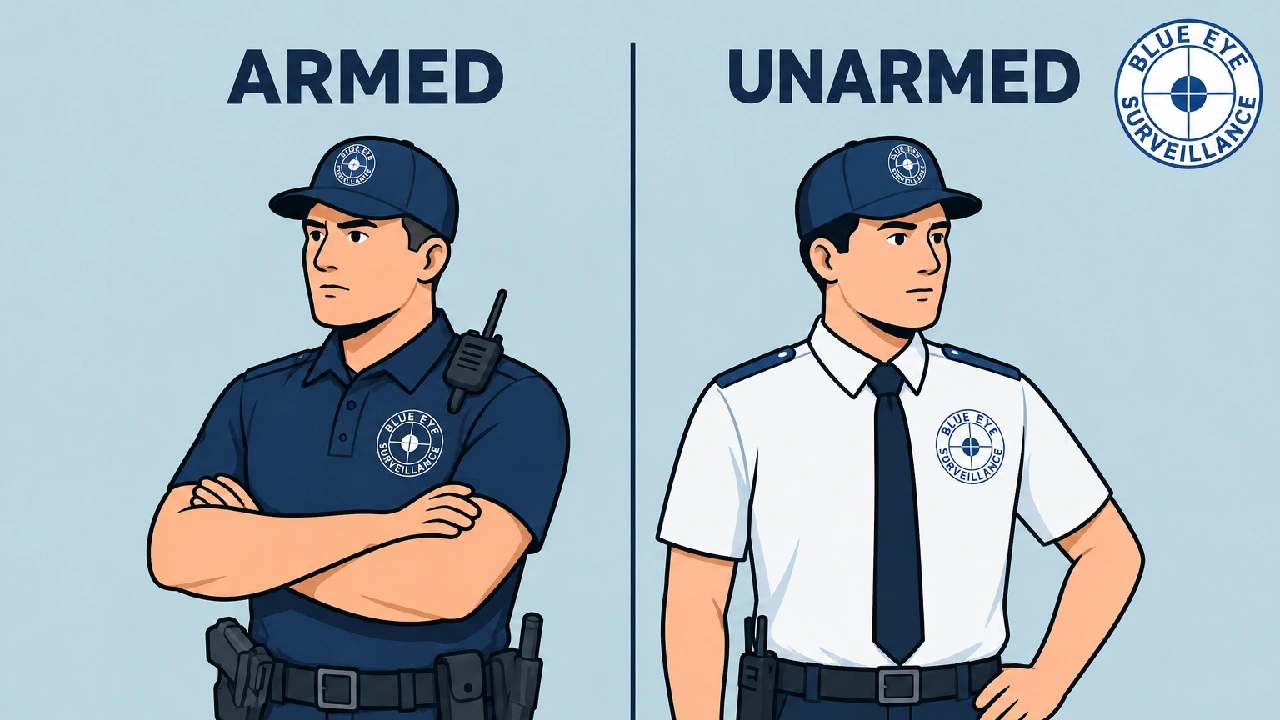
Most businesses don’t need an armed guard. Most think they do, though. That gap — between what feels safer and what actually reduces risk — is where this decision usually goes sideways.
What’s the Actual Difference
An unarmed guard handles access control, patrolling, visitor management, de-escalation when someone’s being difficult at the gate. No firearm. A baton sometimes, a torch, depends on the site. An armed guard carries a licensed weapon and has gone through a separate certification track on top of the standard course — not a weekend add-on, a whole other qualification.
In India, an agency doesn’t just decide to arm someone. The guard needs his own arms license under the Arms Act, 1959, valid specifically for the state he’s deployed in, and most agencies lean toward ex-servicemen for these roles — mostly because they’ve already cleared weapons training somewhere else and the paperwork’s simpler. Not a huge hiring pool, that. Part of why armed deployment costs what it does, honestly.
Side-by-Side Comparison
| Factor | Unarmed Guard | Armed Guard |
| Training | Standard security and access-control training | Standard training plus certified firearms handling |
| Legal requirement | Basic guard certification | Individual arms license under the Arms Act, per state |
| Typical deployment | Offices, residential complexes, retail, events | Cash-heavy sites, high-risk facilities, VIP movement |
| Cost | Lower | Higher — training, licensing, insurance, all of it stacks |
| Perception | Approachable, less intimidating | Strong deterrent, can feel heavy-handed somewhere low-risk |
Neither one’s “better,” not really. They’re solving different problems. A lot of sites genuinely don’t have the kind of problem an armed guard fixes — they just feel like they should have one.
When Unarmed Actually Makes Sense
More ground than people expect, this covers.
- Offices and corporate premises — access control, visitor logs, that’s most of the job and none of it needs a weapon
- Residential societies and gated communities — presence and vigilance do the work here, not firepower
- Retail stores and showrooms — deterrence through visibility, calmly handling the odd dispute at the counter
- Events and gatherings — crowd management, entry checks, someone who knows to call local police the moment things tip past what they can handle
An alert, well-trained unarmed guard stops more incidents just by standing there than people give credit for. The job’s mostly about catching things early. Not confronting them late.
When Armed Protection Is Worth Considering
Fewer situations than the movies make it look, but they’re real.
- Cash-in-transit and high-value cargo — direct financial target, no ambiguity there
- Banks, jewelry showrooms, bullion storage — sites that specifically attract armed criminals, by design almost
- High-risk industrial or remote sites — where police response time runs long enough to actually matter
- VIP and executive protection — depends on the real threat assessment, not the person’s job title on a business card
Even here, armed doesn’t automatically win. A well-run unarmed team with solid CCTV coverage and a fast police-response setup sometimes does more than one guy standing at a gate looking intimidating and, well, not much else.
What Actually Drives the Decision
Three questions. In this order, before anything else gets decided.
- What’s the realistic threat? Not the worst case someone dreamed up at 11pm — the actual, documented pattern for that kind of site
- What does the site really need? A residential building and a cash vault aren’t the same problem wearing different uniforms
- What’s sustainable long-term? Armed deployment isn’t a one-time decision. Licensing renewals, insurance, ongoing weapons re-certification — it keeps coming back, every year, not a box you tick once
Get this wrong either direction and it costs you. Under-securing a genuinely high-risk site — obvious problem. Over-securing a low-risk one isn’t as obviously wrong, but it just means paying more for a deterrent the site never needed. Sometimes it makes staff and visitors more uneasy than an unarmed presence ever would’ve.
How to Actually Decide
- Get a proper risk assessment first — not a guess based on what the office two buildings over is doing
- Match the guard type to the specific site, not the whole company. An office and a warehouse under the same business might need completely different coverage
- Ask what the guard’s actually trained to do past the uniform. De-escalation skill matters more than most people assume — armed or not
- Review it periodically. Risk shifts. What made sense two years back might not now, and nobody checks unless someone makes them
For most offices, residential complexes, retail spaces, and events, professionally trained security guard services cover what the site actually runs into — vigilance, access control, a visible trained presence — without the overhead that armed deployment brings along with it.
Frequently Asked Questions
Is an armed guard always safer than an unarmed one?
No. Depends entirely on the threat. For most sites — offices, homes, shops — an alert unarmed guard handles the real risk just fine. Armed guards solve a narrower, more specific problem.
Do armed guards need a separate license in India?
Yes. Carrying a firearm on duty means an individual arms license under the Arms Act, 1959, valid for whichever state he’s deployed in — on top of the regular guard certification.
Why do armed guards cost more?
Extra weapons training, individual licensing, higher insurance. And it’s recurring — licenses need renewal, certifications lapse, none of it’s a one-time fee.
Can a business use both armed and unarmed guards together?
Yes, and a lot do. Unarmed team running general access and patrol, armed coverage kept at one specific high-risk point — a cash counter, a vault, wherever the actual exposure sits.
Does having an armed guard make visitors feel safer or more uneasy?
Depends where. In a bank, reassuring. In a retail store or a residential lobby, it can read as excessive — actually make people uncomfortable. Perception carries about as much weight as the real risk level does.
How often should a business reassess whether it needs armed security?
Whenever the risk picture shifts — new high-value asset on site, an incident nearby, footfall or location changing. Outside that, once a year is reasonable for most places.