
Ask where the stock keeps going, and most warehouse managers just shrug. It almost never leaves in one dramatic theft. A box here, a pallet there, a delivery that came up short. None of it feels big at the time, but a year of it costs you real money.
Most of it traces back to a few predictable places. A gate nobody watches during the lunch rush. A back door that was locked once, months ago, and never checked since. A camera pointing at a wall. The checklist below is built around those weak points, in roughly the order most sites should deal with them.
Quick answer: what to cover
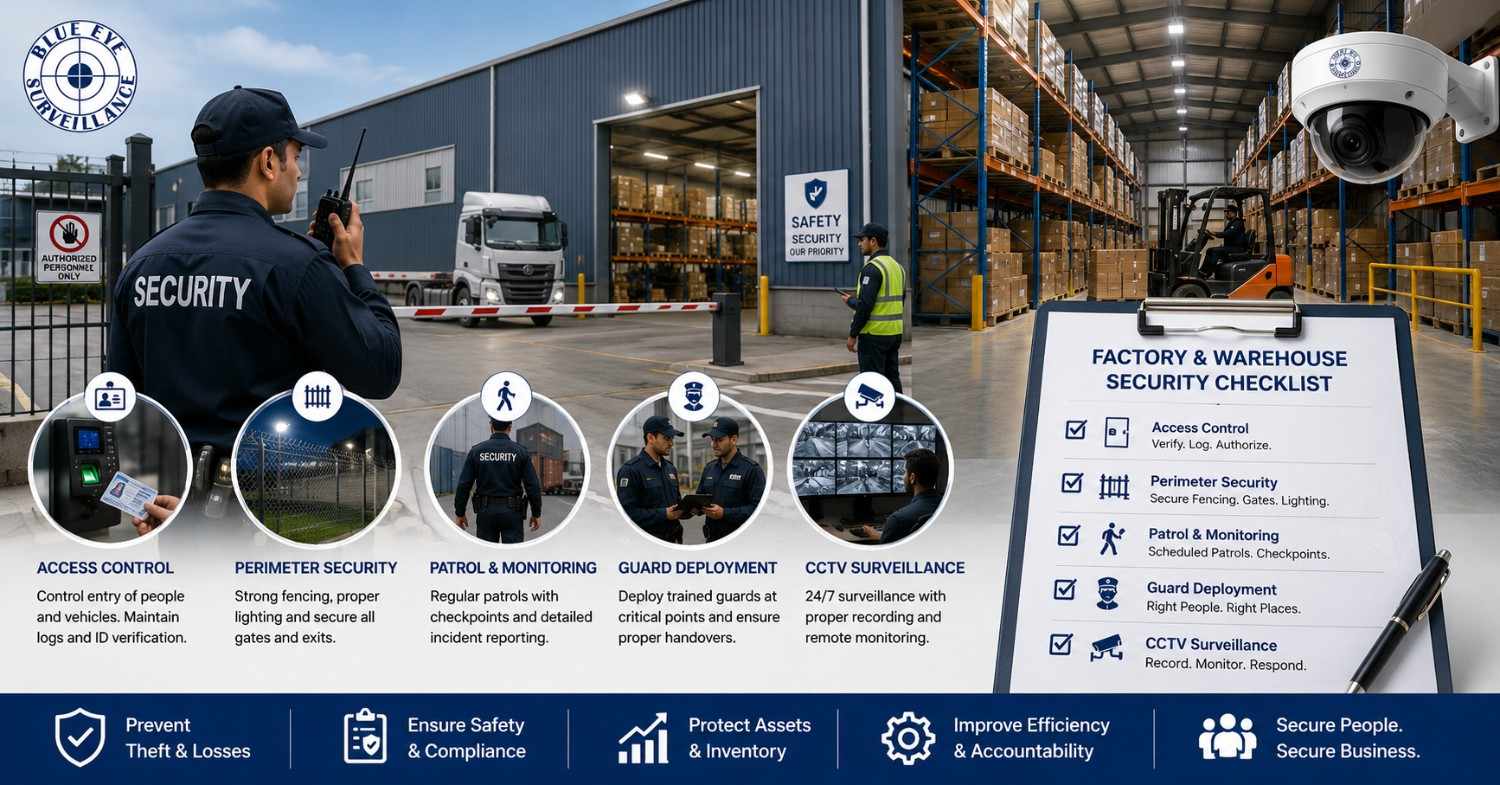
Good factory and warehouse security rests on five things: who you let in, how tight your boundary is, how you patrol, where your guards actually stand, and what your cameras record. Get all five right and you shut off the openings that cause most losses.
Now the detail.
Start with access control
Everything else leans on this one. If you don’t control who comes through the gate, the best cameras and fences money can buy are just decoration.
What you’re aiming for is a site where nobody moves around without being seen, checked, and written down. In practice that means one manned entrance for people, and a separate gate for goods so no truck leaves without someone looking at what’s on it. Staff carry ID passes; visitors get a different badge, so you can tell at a glance who belongs and who’s just passing through. Every visitor and vehicle goes in a log with times in and out. Paper is fine, as long as someone actually fills it.
Lock your high-value storage as well, not just the outer building, and keep the keys with as few people as you can. Then review who holds keys and access cards every few months. People leave, roles change, and old cards have a way of staying live long after they should.
Walk your perimeter, properly
Do this yourself, on foot, at least once. You’ll be surprised what turns up. A fence panel that’s been quietly bent back into place. A stack of pallets left against the boundary wall that works nicely as a ladder. A stretch of fencing that goes pitch black the moment the sun drops.
Sort the lighting first. It’s cheap and it does more good than almost anything else on the list. After that, clear away anything near the fence that offers cover, mark the boundary so there’s no excuse for wandering in, and check that every side and rear gate is genuinely locked rather than just pulled shut.
If you were the one trying to break in, the back of the site is where you’d start. So that’s where to look first when you’re keeping people out.
Patrol on a schedule you can prove
A camera sees; a guard on patrol can actually do something. Someone walking the site catches what a fixed lens never will, whether that’s a propped-open door, a lock that’s been fiddled with, or a face near the stockyard that has no business being there.
Two things make patrols worth the money. Vary the timing, so nobody can simply wait out a round they know is coming. And log each patrol at checkpoints, so you can be sure it happened. A round nobody can verify is a round you’re paying for and can’t rely on. Cover the storage, the docks, and the fence line every time, and note anything odd, even when it seems too small to matter.
Put guards where the losses are
Hiring more guards won’t rescue a badly arranged site. The gate and the loading bay are where most stock walks off, so that’s where your people belong.
A setup that tends to work: one guard on the gate running entries, exits, and vehicle checks; proper cover on loading and unloading, where the boxes actually change hands; and a separate patrol, so gate duty and rounds don’t get dropped for one another. Brief each guard on what to check, what to write down, and who to call when something’s off. And treat handovers seriously. The ten quiet minutes between shifts is when a surprising amount goes missing.
None of it holds up without trained people who stick to the routine day in, day out. Sites that find it hard to keep that standard across every shift often bring in professional security guard services in Mumbai that already run to a set protocol, so cover doesn’t quietly fall apart on a Sunday night.
Let the cameras do the recording
Surveillance holds the rest together. It backs up your access log, gives your patrols a second pair of eyes, and hands you evidence when something does go wrong.
Cover the entries, the loading bays, the storage, and the perimeter. Keep the footage somewhere safe and hold onto it long enough to be useful, because a loss often only comes to light weeks later. Above all, test your night coverage. That’s when it earns its keep, and a camera that whites out under the yard lights or goes blind in the dark isn’t guarding anything.
A well-planned CCTV camera setup does two jobs at once. It puts off people who’d rather not be filmed, and it tells you exactly what happened when someone tries anyway.
The mistakes that keep coming up
The same handful of errors show up on site after site. Owners guard the front and leave the back to fend for itself. Cameras run for months with nobody watching them, so the footage only gets pulled after the loss. There’s no visitor log, which means no way to say who was on site last Tuesday. Patrols run like clockwork, easy to time and easier to dodge. Handovers happen on the way out the door.
What’s frustrating is that none of these is expensive to fix. That’s exactly why they’re worth fixing first.
Where to begin
Take this checklist and walk the site, gate to storage to fence line, writing down every gap as you go. Deal with the cheap wins first: lighting, locks, a visitor log, fixed patrol times. Only then spend on anything bigger, and put that money where your most valuable stock sits. After that, it’s just a matter of coming back to the list every few months. Sites shift, stock moves, and new blind spots appear the moment you stop looking for them.
Frequently asked questions
What’s the most important part of warehouse security?
Access control, with little competition. Once you know who’s coming in, who’s leaving, and who’s moving stock, and it’s all written down, you’ve already closed off most of the easy routes to theft.
How many guards does a factory or warehouse need?
There’s no fixed number. It depends on the size of the site, how many ways in there are, and how valuable the stock is. Cover the gate, the loading area, and your patrols first. Where you place guards counts for far more than how many you have.
Do CCTV cameras replace security guards?
No. Cameras record and put people off, but they can’t step in during an incident or make a judgement call on the spot. They do their best work alongside guards, with the cameras watching and the guards responding.
How often should security be reviewed?
Walk the site every three to six months, and again whenever you change the layout, add stock, or notice something new that bothers you. Sites don’t stand still, and the checklist shouldn’t either.
What causes the most stock loss in warehouses?
Loading and unloading points, material gates that go unchecked, and weak perimeters. Goods move quickly at those spots and attention tends to slip, which is precisely why they deserve the most of it.