

Five years ago, your office probably had one entrance, fixed hours, and a guard who knew every face by name. Not anymore. Hybrid schedules mean half the floor is empty on a Tuesday and full on a Wednesday. Open layouts replaced cabins. And in places like Andheri MIDC or Thane’s Wagle Estate, a dozen companies now share one lobby, one lift bank, one parking lot — nobody’s quite sure whose visitor is whose.
That’s the gap. Not a dramatic one. Just a quiet one, where someone walks in who shouldn’t, and nobody notices until later.
A logbook at reception used to be the whole plan. It isn’t anymore.
Why This Isn’t Something You Fix After the Fact
Here’s the pattern, and if you run an office in Mumbai you’ve probably lived some version of it: nothing happens for months, then a laptop’s gone, or a visitor was on the fourth floor for twenty minutes and nobody knows why. That’s usually when the security conversation starts. Which is backwards — the cost of dealing with it after is always higher than the cost of preventing it, and not just in rupees.
The risks aren’t exotic. They’re the same five, over and over:
- Unauthorized entry — a visitor, a delivery guy, an ex-employee who still remembers the way to the fourth floor
- Theft — laptops, files, hardware, gone from a desk nobody was watching
- Disputes that go sideways — between staff, or with an outsider, with no one trained to step in before it escalates
- Emergencies with no plan — fire, a medical situation, and everyone just… looking at each other
- Empty buildings at night — weekends, long holidays, 11 PM on a Thursday, when most of this actually happens
What Actually Goes Into a Security Setup
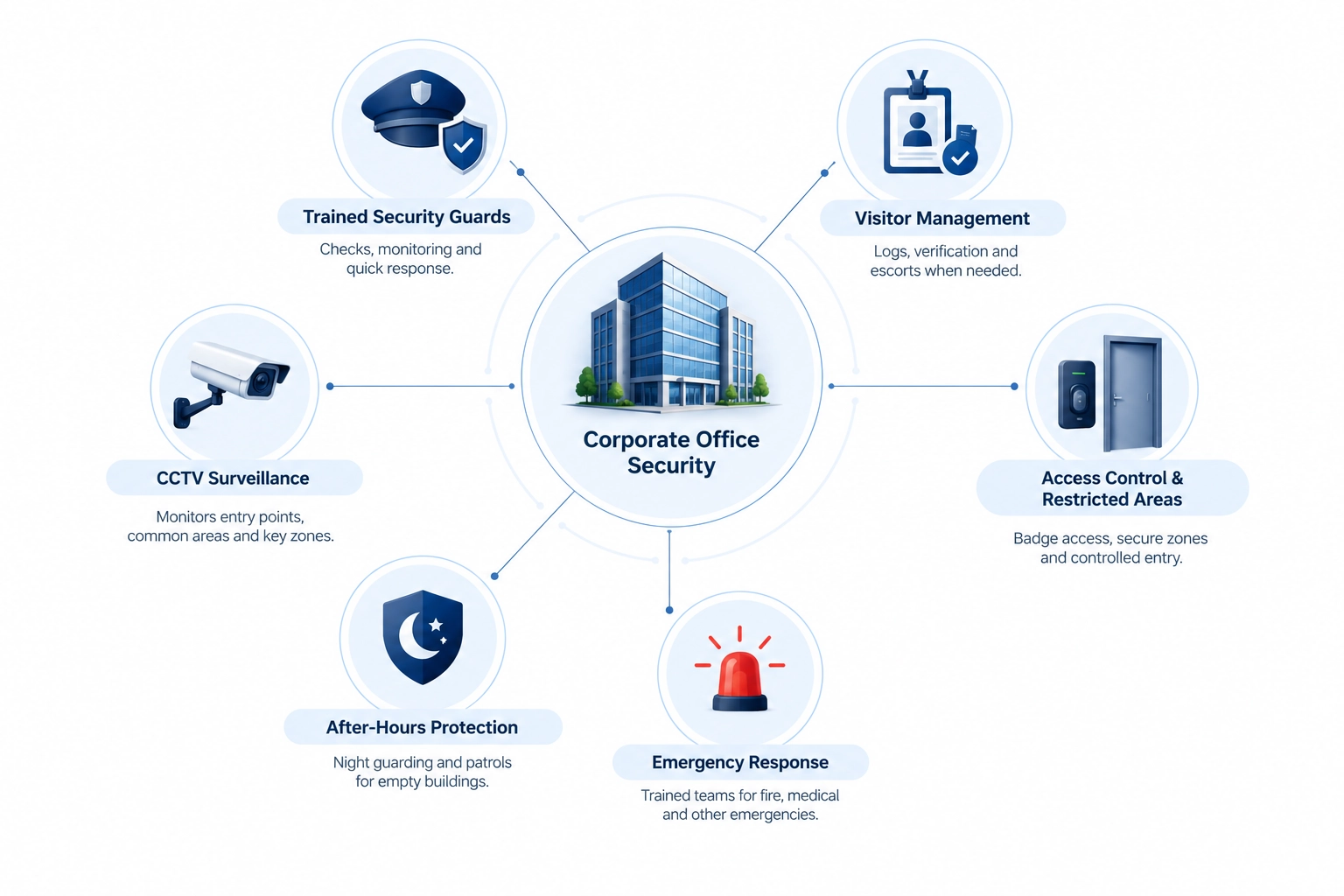
It’s not one thing. It’s five, roughly, stacked on top of each other.
A guard who does more than stand there. Checks identity, logs who’s coming and going, knows which floors need what level of access. A guard trained for one specific building — not rotated in from a warehouse last week — responds differently when something actually happens.
Visitor management, properly done. Every person — vendor, interview candidate, courier — gets logged, and escorted if the situation calls for it. Finance and legal floors, server rooms, these usually need badge-only access with a guard actually enforcing it, not just a sign on the door.
CCTV, placed with some thought. Entry points, parking, lobbies, corridors. Six well-angled cameras beat twenty bad ones — camera count is not the metric that matters, coverage is.
Someone who knows what to do when things go wrong. A fire alarm, a medical situation, a visitor getting aggressive — trained personnel handle these without the whole floor finding out the hard way that nobody had a plan.
Coverage after the lights go off. Most break-ins don’t happen at 2 PM with the office full. They happen at night, on a long weekend, when the building’s empty and nobody’s watching. This is the gap most businesses just… leave open.
Matching the Risk to the Right Measure
Not everything needs the same weight. Here’s roughly how the risks map to what actually addresses them.
| Risk | What Handles It | Why |
| Unauthorized entry | Guard + visitor logging | A person at the door catches what a swipe card alone won’t |
| Theft of equipment or files | CCTV + restricted zones | Deters it, and there’s a record if it still happens |
| Disputes or aggressive visitors | Trained guard on-site | De-escalation needs a person, not a lens |
| Fire or medical emergencies | Staff trained to respond | Speed matters more than footage afterward |
| After-hours break-ins | Night guarding or patrols | Empty buildings are the easiest target |
| Server room access | Badge access + guard-enforced boundary | Technology plus a human checkpoint |
What to Actually Check Before You Hire Someone
A few questions worth asking before you sign anything:
- Are their guards trained for corporate offices specifically, or is this the same guy who did a warehouse shift last week?
- Is there an actual escalation process — who gets the call first, and how fast do they show up?
- Do they know your building — entry points, parking layout, when footfall peaks — or is the deployment a copy-paste job?
- Can coverage flex up during an audit, an event, a high-visitor week, and back down when it’s quiet?
- Do they pair guards with CCTV, or is it one or the other?
A guard with no cameras, or cameras with no one watching — either way, you’ve solved half the problem.
Where Most Offices Go Wrong
A handful of mistakes keep showing up, across office after office:
- Setting up security once and never revisiting it, even after the office adds a floor or triples in headcount
- A reception desk doing the job of a full visitor process, with no actual verification behind it
- Cameras installed, then never checked until after something’s already happened
- Daytime-only coverage, with nights and weekends left wide open
- Guards who know the general rules but not this building — so response during an actual incident is inconsistent
Frequently Asked Questions
What does corporate security actually include?
Guarding, visitor management, CCTV, and emergency response — not as separate things, but working together.
Does a small office need the same setup as a big one?
The scale’s different. The risks aren’t — unauthorized entry and theft don’t care how many desks you have. Smaller offices usually need a lighter version of the same layers, not something entirely different.
How many guards does an office actually need?
Depends on entry points and footfall, mostly. One reception, one shift, maybe one guard. Multiple floors and access points means deployment mapped to each one — there’s no single number that fits every building.
Should the same company handle guards and CCTV?
Usually, yes. When it’s one provider, a guard can act on what a camera just caught, instead of someone reviewing footage two days later and wondering what to do about it now.
Is an alarm system enough without after-hours guarding?
An alarm tells you after someone’s already inside. A guard or a monitored patrol is there before that happens — which is a different kind of protection, not a smaller version of the same one.
Bringing It Together
Security isn’t a single purchase you make once and forget. It’s guarding, access control, cameras, and a plan for when something actually goes wrong, layered so each one catches what the others miss. The offices that stay ahead of this are usually the ones that revisit the setup as they grow — not the ones with the fanciest cameras.
Blue Eye Surveillance works with offices across Mumbai and Thane on exactly this — building the setup around how a specific building actually runs, not a template. If it’s been a while since anyone looked at yours, that’s usually where to start.