Hire a security agency when a guard not showing up would genuinely hurt you — you’re paying more, but you’re buying vetted people, insurance, and a replacement on standby. Go freelance when the job’s small, short, or tight on budget — and you don’t mind doing the vetting and scheduling yourself. That’s the gist. The rest breaks it down so you can make the call and not kick yourself later.
Security agency vs freelance guard: the quick version
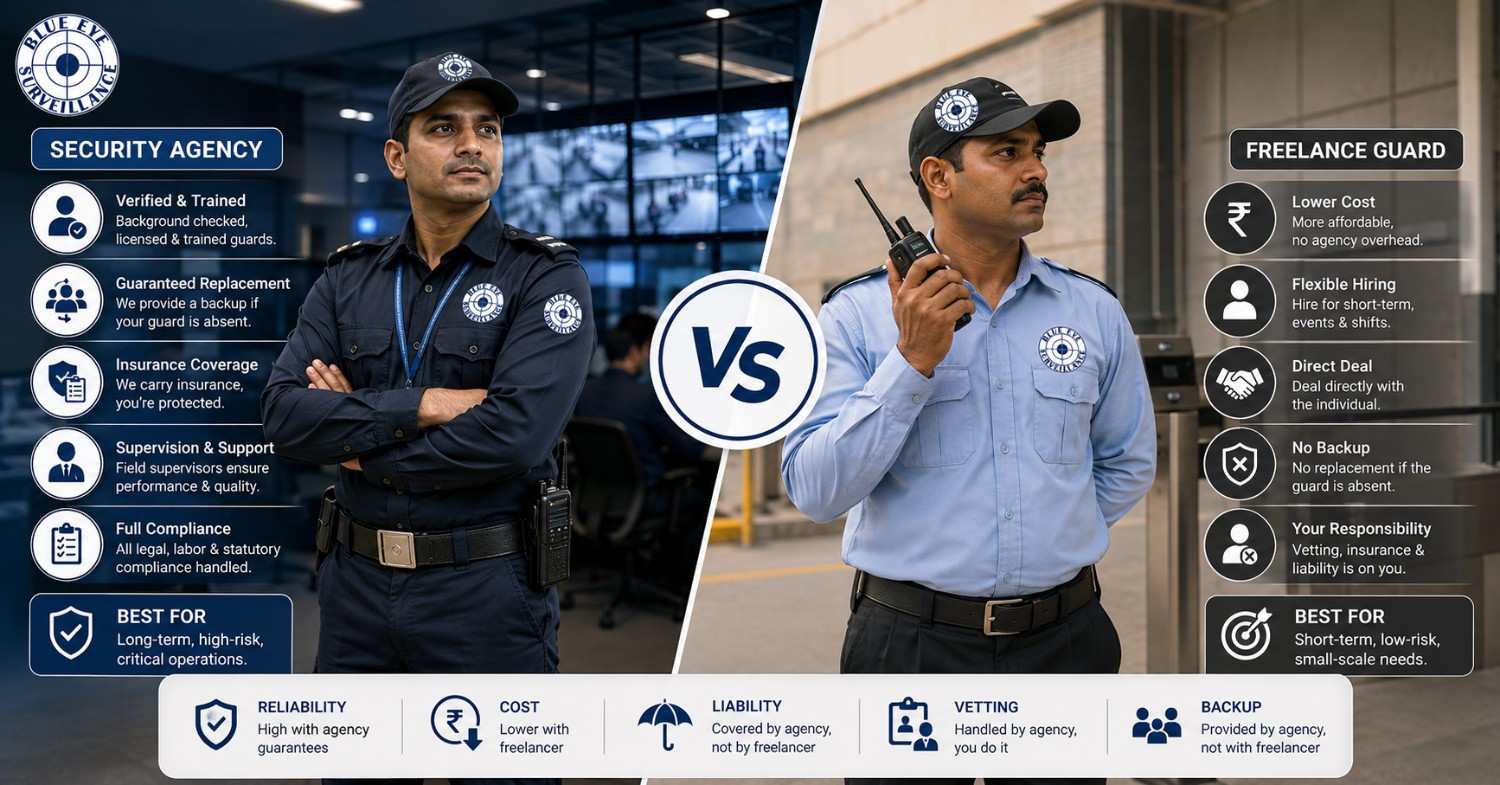
It really comes down to five things: reliability, cost, liability, who does the vetting, and what happens when your guard calls in sick. A freelancer tends to win on price and flexibility. An agency wins on nearly everything that saves you when something goes sideways.
Here’s how they stack up:
- Cost. An agency costs more — you’re covering their overhead and margin on top of the wage. A freelancer is a direct hire, so you pay less.
- Vetting and training. An agency handles this and keeps the paperwork. With a freelancer, checking their licence and background is on you.
- Insurance and liability. An agency carries the cover. With a freelancer, that risk usually lands in your lap.
- Backup. If an agency’s guard is sick, they send someone else. If your freelancer is sick, you’ve got an empty post.
- Flexibility. Agencies work on contracts. A freelancer you can book for a weekend and drop the next.
- Supervision. Agencies send field supervisors to keep standards up. A freelancer, you manage yourself.
- Best fit. Agencies suit ongoing, high-stakes sites. Freelancers suit short-term, low-risk jobs.
What is a security agency?
A security agency is a licensed company that supplies the guards and takes care of everything around them — vetting, payroll, uniforms, insurance, supervision — and promises a replacement if someone doesn’t turn up. You sign a contract, pay one rate that folds all of that in, and manage a single relationship instead of a small workforce.
That bundle is where the money goes, and it’s worth understanding what you’re actually paying for.
Continuity is the big one. A guard quits or gets the flu, and the agency quietly sends a trained replacement. You often don’t even hear about it. Your post is never empty, which is the whole point of hiring security in the first place.
Liability sits with them, not you. Reputable agencies carry public liability and workers’ compensation cover. So if something goes wrong on-site — an injury, a confrontation — you’re not the one left holding the bill.
Compliance is handled and on file. They keep you compliant without you lifting a finger — licences, background checks, and required training all logged and kept current, so you’re covered the day an auditor knocks.
Someone’s actually watching the guards. Field supervisors swing by to check on things and sort out complaints, so the quality doesn’t quietly slide the moment you look away.
The catch? You pay a premium for all of it. Contracts can be rigid, and because guards rotate, the person on your site may never learn your premises the way a dedicated regular would.
What is a freelance guard?
A freelance guard is someone you hire directly, with no company in between. You agree on a rate, a schedule, and what you need done, and you deal with that one person. It’s cheaper and a lot more flexible — but every job the agency would have quietly absorbed now belongs to you.
For the right situation, that’s a fair trade:
- You pay less. No agency margin, no overhead. The hourly rate is usually noticeably lower.
- You can move fast. Need someone for one event, one weekend, or an odd shift pattern? No contract to negotiate.
- You get one consistent face. A good freelancer learns your site, your routines, and your regulars — the kind of familiarity a rotating roster never builds.
Now the part people underestimate:
- There’s no backup. If your freelancer is sick, injured, or just doesn’t show, your site is unguarded and there’s nobody to call. This is the single biggest risk of going freelance.
- The vetting is yours. You have to confirm their licence, check references, and verify training yourself. Skip that step and any fallout is on you.
- So is the liability. Depending on where you are, an untrained or uninsured guard can leave you carrying the legal and financial risk after an incident.
- And so is the admin. Scheduling, paying them, managing performance — that’s all your job now.
When to hire a security agency
Go with an agency when the cost of a gap is bigger than the cost of the premium. If your site runs around the clock, holds real value, faces genuine risk, or has to satisfy insurers or regulators, the guaranteed coverage and the documented compliance quietly pay for themselves.
Picture warehouses, building sites, retail chains, offices, hospitals — anywhere a guard going missing for one shift could mean stock walking out, someone getting hurt, or a failed audit. In those places, “we’ll just find someone” isn’t a plan.
When a freelance guard makes sense
Go freelance when the job is small, short, or low-risk and you’ve genuinely got the time to manage one person well. A private party, a short-term vacancy, a small shop, overnight cover for a quiet site — the right individual can handle any of these, as long as you’ve checked their licence and insurance first.
Really, it comes down to one honest question: if this guard doesn’t turn up tomorrow, what does it actually cost me ? If the honest answer is “not much,” a freelancer is a smart, economical choice. If it’s “a lot,” you want an agency’s backup guarantee behind you.
How to decide: five quick questions
- How high is the risk? What’s really at stake if security fails? When a lot can go wrong, an agency starts to make real sense.
- How long do you need it? Ongoing cover leans agency. A one-off leans freelancer.
- Cheap now, or cheap overall? A lower rate isn’t a saving if a single incident wipes it out.
- Can you survive an empty shift? If the answer is no, you need guaranteed replacement — and that means an agency.
- Do you have time to manage it? Vetting, scheduling, supervising — if you can’t spare that, pay someone who will.
One more thing, whichever way you lean: a guard alone leaves blind spots, because no single person can watch every entrance at once. Backing your people up with 24/7 CCTV monitoring covers what human eyes miss — and gives you a record when it counts.
Frequently asked questions
Is a security agency more expensive than a freelance guard?
Usually, yes. An agency’s rate covers vetting, training, insurance, supervision, and someone to fill in when a guard’s out — so naturally you pay a bit more for it. . A freelancer costs less because you’re taking all of those on yourself.
Are freelance security guards legal to hire directly?
In most places, yes — but the guard normally needs a valid security licence, and the rules shift from region to region. Check their licence and insurance before day one, and see what your local law asks for.
What happens if a freelance guard doesn’t show up?
Your site is left unguarded, because there’s no company standing by to send a replacement. It’s the biggest downside of hiring freelance, and it’s exactly the gap an agency contract is built to close.
Can I combine a freelance guard with cameras instead of an agency?
Yes, and for lower-risk sites it’s a genuinely cost-effective setup. A guard plus solid camera coverage can match a lot of what an agency offers, for less — as long as you still handle the vetting, the insurance, and a plan for the days your guard can’t make it.
Which is better for a one-time event?
For a single event, a freelance guard is usually the better call: cheaper, more flexible, no long-term contract to sign. Just confirm their licence and check they’ve worked at your kind of event before.
Conclusion
There’s no “better” option in the abstract — there’s only the one that fits your risk. If a missed shift or an uninsured incident would seriously set you back, an agency’s guarantees are worth every extra dollar. If your needs are modest and you can stay on top of the details, a vetted freelancer saves money without much downside. Be honest about what you stand to lose, and the right choice usually picks itself.