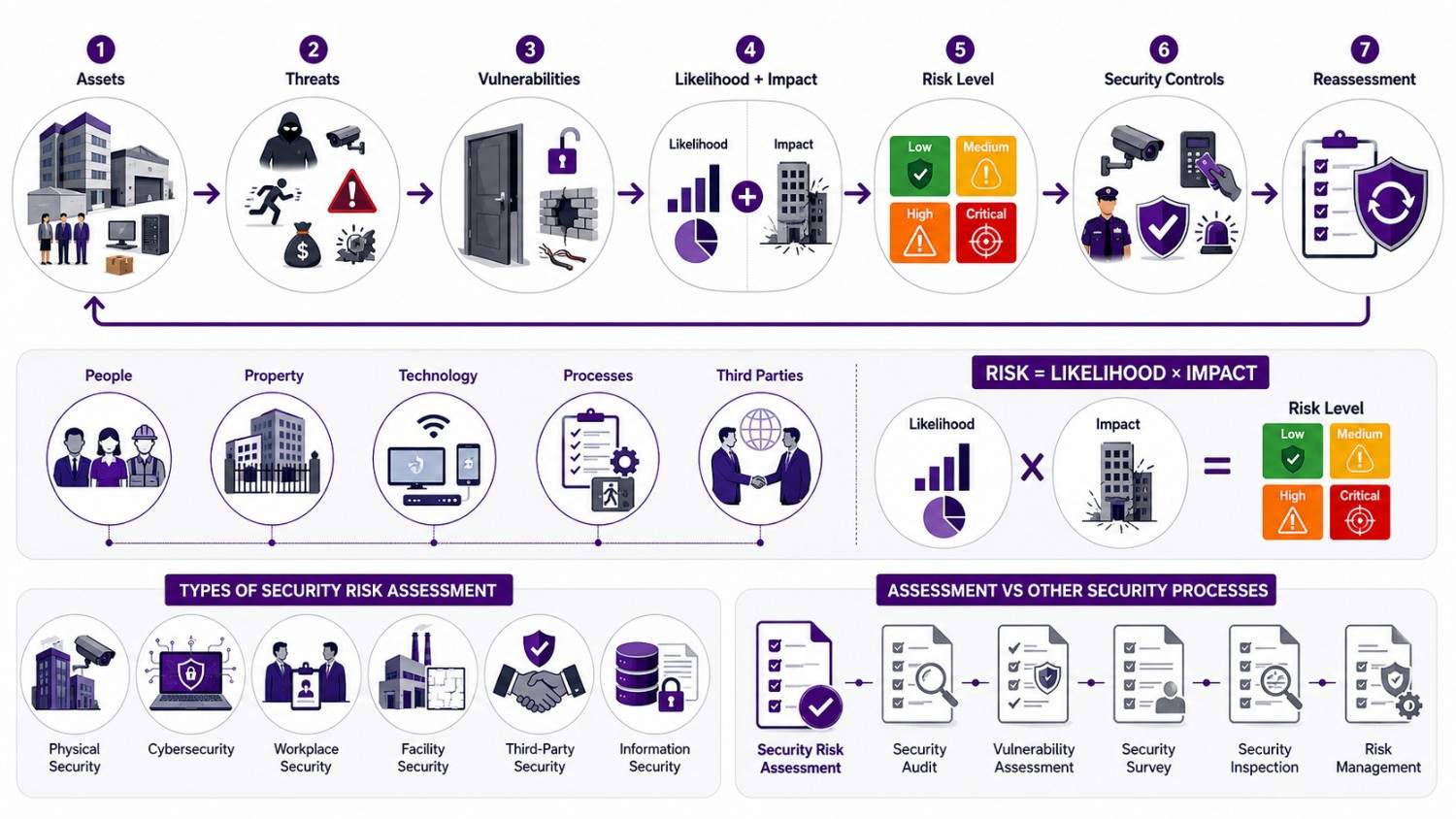
A security risk assessment looks at the assets, the threats, and the vulnerabilities first — then weighs likelihood against impact to figure out which controls are actually worth it.
It looks at people, property, technology, and processes — not just IT systems, though most articles online will tell you otherwise. The goal is simple: find the weak points before someone else does.
Take an office with an unlocked rear entrance. That’s the vulnerability. Someone walking in without authorization is the threat. Whether that’s a real risk or a minor one depends on how likely it is to happen and what it costs if it does.
What Does a Security Risk Assessment Cover?
- People — employees, visitors, contractors
- Property — buildings, entrances, perimeter
- Technology — networks, data, devices
- Processes — access procedures, emergency response
- Third parties — vendors and external partners
A factory assessment tends to focus more on physical access and machinery than on servers. A software company usually flips that. A hospital typically needs both, along with a close look at emergency operations for patients and staff.
Scope isn’t something you set once and reuse — it comes from what the organization actually has to protect.
Key Elements of a Security Risk Assessment
Assets — What needs protection. A building, a server room, a warehouse of stock.
Threats — What could cause harm. Theft, unauthorized entry, sabotage.
Vulnerabilities — What weaknesses could be exploited. A broken lock, an unmonitored entrance.
Likelihood — How likely the event is, based on history and exposure.
Impact — What happens if it occurs, in cost, safety, or disruption.
Risk Level — How serious the resulting risk is once likelihood and impact are combined.
Security Controls — What reduces the risk. CCTV, guards, access control, alarms.
How Does a Security Risk Assessment Work?
- Define the scope
- Identify critical assets
- Identify threats
- Find vulnerabilities
- Analyze likelihood and impact
- Prioritize risks
- Recommend and implement controls
The report isn’t really the finish line. Someone still has to review, monitor, and reassess after it’s handed over.
Types of Security Risk Assessments
- Physical security — buildings, CCTV, access control, guards
- Cybersecurity — networks, devices, data
- Workplace security — employee and visitor safety
- Facility security — site layout and critical rooms
- Third-party security — vendors and contractors
- Information security — data confidentiality and integrity
Most organizations end up needing more than one. A retail store, for instance, combines physical security with information security to cover the shop floor and customer payment data at the same time.
How Do You Calculate and Prioritize Security Risk?
Security risk isn’t guesswork. It’s really just Risk = Likelihood × Impact. Once you’ve got a sense of how likely something is and how bad it’d be if it hit, ranking risks stops being a guessing game.
- Low likelihood, low impact — Low risk. Monitor, but no urgent action needed.
- Medium likelihood, medium impact — Medium risk. Address within a reasonable timeframe.
- High likelihood, high impact — High risk. Requires prompt action.
- High likelihood, critical impact — Critical risk. Immediate action required.
A low-likelihood, low-impact issue can usually sit for a while. A high-likelihood, high-impact one can’t wait that long. That’s really the whole point of prioritizing — without it, everything on the list looks equally urgent, and in practice that means nothing gets fixed first.
What Happens After a Security Risk Assessment?
- Report — documents findings and priorities
- Risk register — records identified risks
- Recommended controls — what should change
- Treatment plan — avoid, reduce, transfer, or accept
- Reassessment — follow-up over time
A report that just sits there doesn’t protect anything. The actual value shows up later, once someone acts on it.
Security Risk Assessment vs Security Audit vs Security Survey
These terms get used interchangeably, but each one is answering a different question.
- Security Risk Assessment — What could go wrong, and how serious is it? Identifies assets, threats, and vulnerabilities, then evaluates and prioritizes risk.
- Security Audit — Are required controls and policies being followed? Checks compliance against a defined standard or requirement.
- Vulnerability Assessment — What weaknesses exist? Identifies gaps without evaluating business impact or likelihood.
- Security Survey — What security conditions exist at a site? A physical review of a location’s current state.
- Security Inspection — Is a specific security measure working as expected? A narrow, targeted check.
- Risk Management — How are risks managed continuously? The ongoing process that the assessment feeds into.
Of the six, the risk assessment covers the most ground — it’s the one that ties findings back to actual business and safety impact, rather than just recording what’s there.
Security Risk Assessment FAQs
What is a security risk assessment?
A structured process that identifies assets, threats, and vulnerabilities, then evaluates and prioritizes risk.
Why is it important?
It finds weak points before they’re exploited, instead of after something’s already gone wrong.
What does it include?
People, property, technology, processes, and third parties — how much of each depends on the organization.
What are the 7 steps?
Scope, assets, threats, vulnerabilities, likelihood and impact, prioritization, controls.
How is it different from a security audit?
An audit checks whether controls are followed. A risk assessment looks at what could go wrong and how serious it would be.
How is security risk calculated?
Risk = Likelihood × Impact.
Who can conduct one?
Trained internal security staff, or an external provider, depending on scope.
How often should it happen?
Regularly — and again after any major change to the site, systems, or operations.