
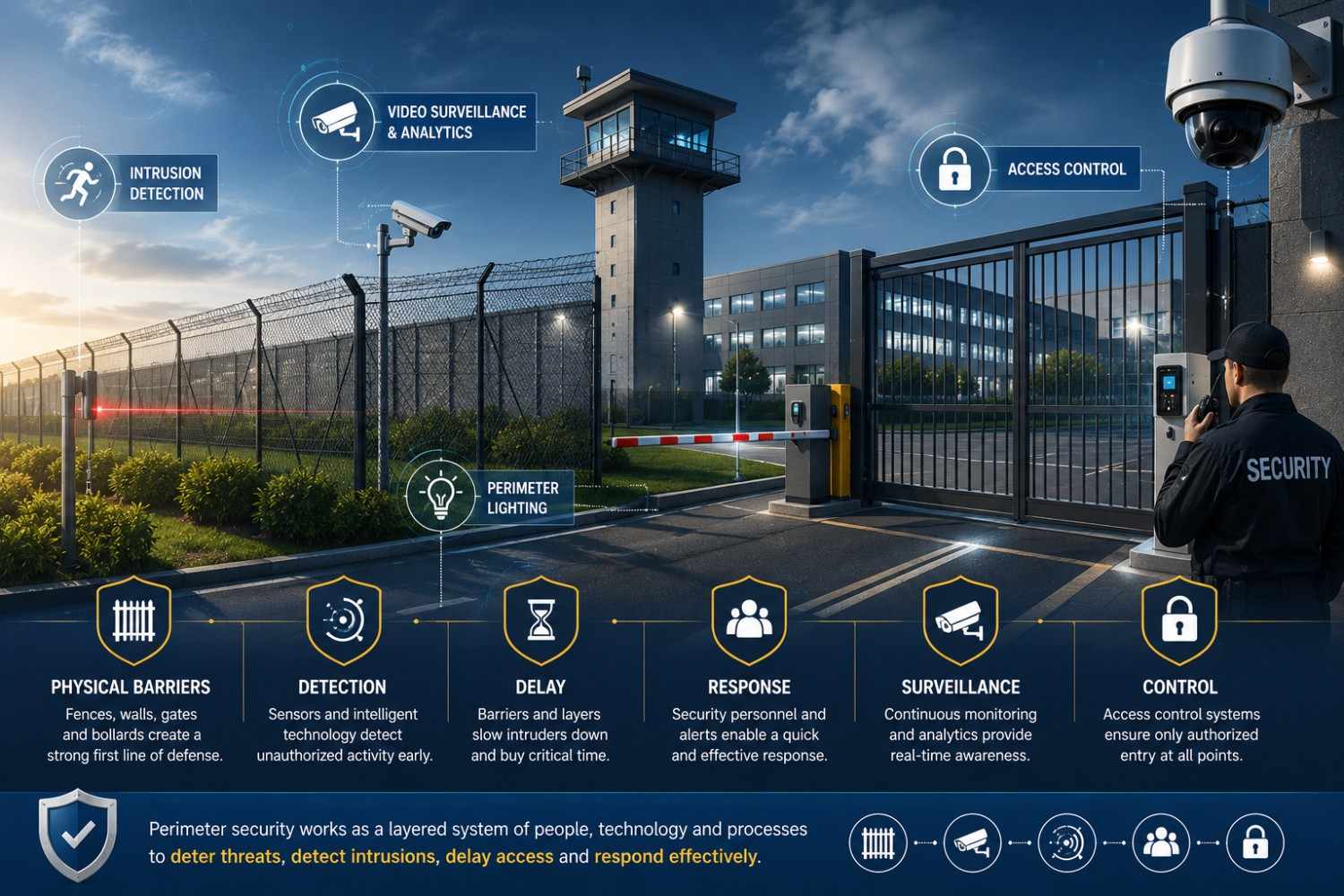
Perimeter security is the outer layer of protection around a property or facility — the fences, gates, cameras, sensors and people that stop or slow down anyone who shouldn’t be there. It’s not one device. It’s not a fence with a camera bolted on. It’s barriers, detection, surveillance, access control and a response plan, working as one system, not five separate purchases.
How Does Perimeter Security Work?
Four stages, roughly in this order: deter, detect, delay, respond. A fence or a wall does the deterring — most people won’t even try. If someone does try, a sensor picks up movement or vibration and fires an alert. The barrier itself buys time here, that’s the delay part, slowing an intruder down long enough for the next step to matter.
Then a camera confirms what’s actually happening — person, animal, blowing debris — and a guard or a control room responds. Remove any one stage and the other three do more work than they should.
What Are the Main Components of Perimeter Security?
| Component | Purpose |
| Fences/walls | Create a physical boundary |
| Gates/access control | Control authorized entry |
| Security lighting | Improve visibility and deterrence |
| CCTV/video analytics | Monitor and verify activity |
| Intrusion sensors | Detect climbing, cutting or movement |
| Barriers/bollards | Stop or slow vehicles |
| Security personnel | Verify and respond to threats |
None of these work particularly well alone. A camera with no light source is half-blind after dark. A fence with no sensor just tells you where someone got in, after the fact. Layer them and the gaps close — mostly.
What Are the Types of Perimeter Security?
Physical — walls, fences, gates, bollards. The stuff you can touch.
Electronic — sensors, CCTV, alarms, access control. Detection without a person standing there.
Smart / AI-enabled — video analytics, thermal cameras, radar, integrated sensor networks. This is where a system starts telling the difference between a stray dog and an actual intruder on its own.
Most sites don’t pick one category and stop. A warehouse might run a fence, a few sensors, and one AI camera at the gate — physical, electronic and smart, all on the same 200 metres of boundary.
What Technologies Are Used in Perimeter Security?
| Technology | Best for |
| CCTV + AI analytics | Detecting and classifying people/vehicles |
| Thermal cameras | Low-light and long-range detection |
| Radar | Wide-area movement detection |
| Fence sensors | Detecting cutting/climbing |
| Access control | Controlling entry points |
| Security lighting | Visibility and deterrence |
Thermal plus radar plus video analytics is the combination getting the most attention right now, mainly because it cuts down on false alarms — a branch swaying in the wind sets off a plain motion sensor, but it doesn’t read as a person on thermal. If cameras are the piece you’re weighing first, our CCTV Camera Security page covers what’s actually involved in setting one up.
Why Is Perimeter Security Important?
- Prevents unauthorized access before it becomes a bigger problem
- Detects threats early
- Delays intruders long enough for a response
- Protects people, property and assets on site
- Gives security teams actual time to act
Take a warehouse at 2 AM. The fence slows someone down, a sensor on the line triggers an alert, and an AI camera flags it as a person, not a stray cat — someone’s looking at a screen instead of finding out in the morning.
Where Is Perimeter Security Used?
Warehouses and logistics facilities, data centers, airports, manufacturing plants, power and utility facilities, government sites, commercial properties, residential communities. What a data center needs and what a residential society needs aren’t the same list — site layout, what’s inside, the threat level, and how fast someone needs to respond all shape the system.
How to Choose a Perimeter Security System
- Identify what actually needs protecting
- Work out the likely threats — theft, trespassing, vandalism, something else
- Assess the terrain — flat open ground behaves nothing like a wooded boundary
- Choose layers that cover each other’s blind spots
- Plan who monitors it and who responds, and when
The newest sensor on the market isn’t automatically the right one for a given site. Risk decides the system, not the product catalog — our Risk Assessment Guide walks through step 2 in more depth if that’s where you’re stuck.
Perimeter Security vs. Physical Security
| Perimeter Security | Physical Security |
| Protects the outer boundary | Protects the entire physical environment |
| Focuses on early detection, deterrence and access | Includes perimeter, buildings, people, assets and internal areas |
Perimeter security is one piece of physical security — the edge of it, not the whole picture.
Frequently Asked Questions
What is the main purpose of perimeter security?
To stop unauthorized access at the boundary, before it reaches people or buildings inside.
What are the main components of perimeter security?
Fences or walls, gates and access control, lighting, CCTV, intrusion sensors, and barriers — usually backed by personnel.
Is a fence considered perimeter security?
Yes, but it’s one layer among several. A fence deters and delays; it doesn’t detect or respond on its own.
What is the difference between perimeter security and physical security?
Perimeter security covers the boundary. Physical security covers everything inside it too.
What technologies are used in modern perimeter security?
CCTV with AI analytics, thermal cameras, radar, fence sensors, and access control, often combined.
How can perimeter security reduce unauthorized access?
Through deter-detect-delay-respond — barriers discourage entry, sensors catch what gets through, and a timely response closes the loop